

AI Agent Frameworks Compared: LangChain vs CrewAI vs AutoGen
Compares LangChain, CrewAI, and AutoGen across architecture model, use case fit, developer experience, production-readiness, and cost — with specific guidance on which framework to choose for different agent task types and a frank assessment of where each breaks down.
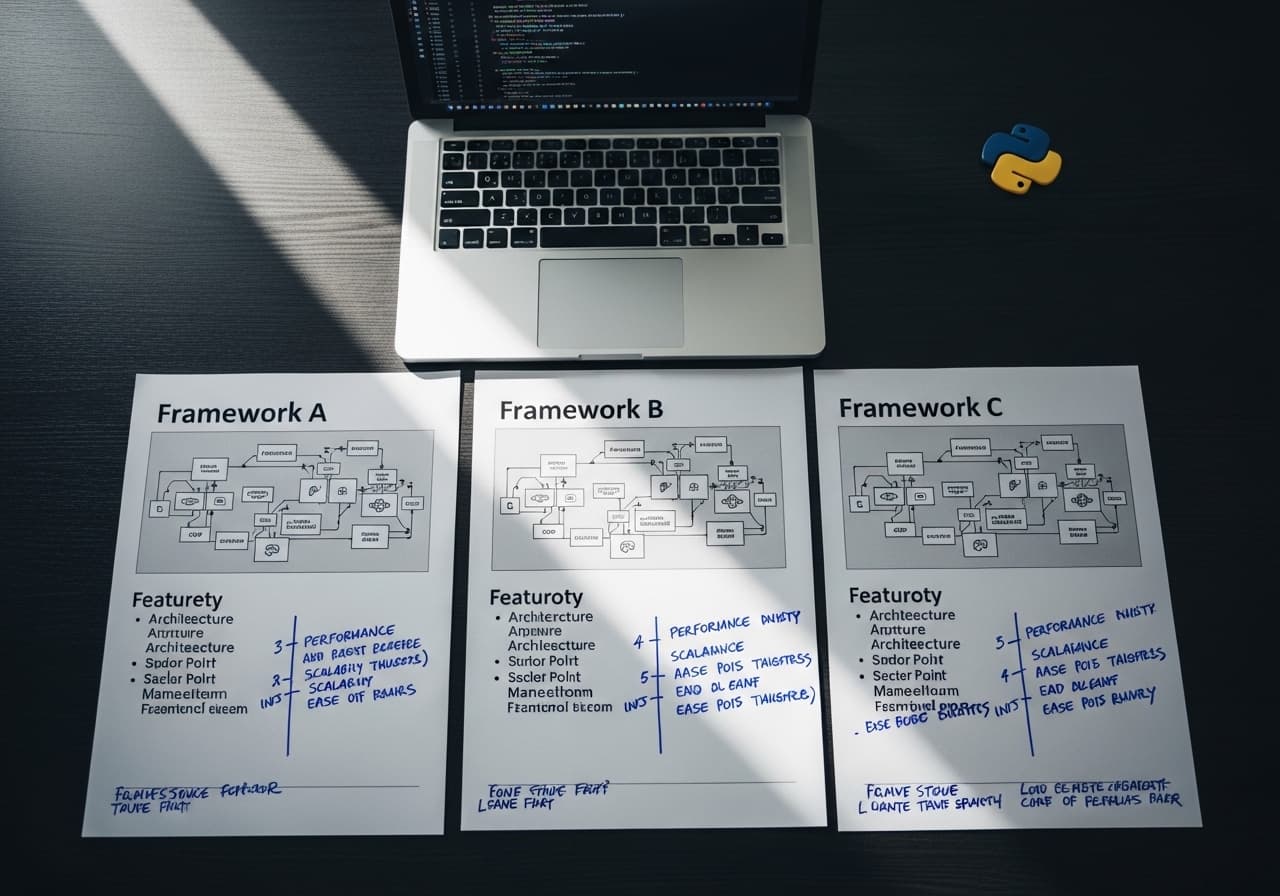
AI Agent Frameworks Compared: LangChain vs CrewAI vs AutoGen
An AI agent framework is a library that orchestrates LLM calls, tool use, memory, and multi-step reasoning into a structured execution loop — enabling a model to take sequences of actions toward a goal rather than responding to a single prompt. LangChain, CrewAI, and AutoGen are the three most widely used frameworks in 2026, each with a distinct architecture model and a different fit for different task types. Choosing the wrong one creates unnecessary complexity; choosing the right one accelerates development significantly.
How AI Agents Work
An AI agent is an LLM equipped with tools (functions it can call) and a reasoning loop (plan → act → observe → repeat) that allows it to take multi-step actions toward a goal. A single LLM call answers a question. An agent with web search, code execution, and file writing tools can research a topic, write and execute code, and produce a formatted report — autonomously across 10–20 steps.
The framework provides the scaffolding: tool registration, execution loop management, memory, and output parsing.
LangChain
Architecture: Chain-based and agent-based. LangChain Expression Language (LCEL) for composing deterministic chains. LangGraph (a LangChain subproject) for stateful, graph-based agent workflows with explicit state management.
Strengths: Largest ecosystem (hundreds of integrations), most mature RAG pipeline tooling, LangGraph gives fine-grained control over agent state and execution flow, strong community and documentation.
Weaknesses: High abstraction overhead makes debugging difficult, rapid API changes have historically broken production pipelines between versions, overkill for simple single-step LLM integrations.
Best for: RAG pipelines, complex multi-step agents requiring explicit state management (use LangGraph), applications integrating with many different tools and data sources.
CrewAI
Architecture: Role-based multi-agent orchestration. You define a crew of agents, each with a role (Researcher, Writer, Critic), a goal, and a backstory. Agents collaborate on a task, passing outputs between each other in a defined sequence or hierarchy.
Strengths: Intuitive mental model for multi-agent workflows, fast to prototype (a multi-agent pipeline can be built in hours), good for tasks that naturally decompose into specialist roles.
Weaknesses: Less control over execution flow than LangGraph, production-readiness is lower (error handling and retry logic require more custom work), role-based abstraction becomes a constraint for tasks that don't fit the team-collaboration metaphor.
Best for: Content research and generation pipelines, workflows that decompose into distinct specialist steps, rapid prototyping of multi-agent systems.
AutoGen (Microsoft)
Architecture: Conversational multi-agent framework. Agents communicate through message-passing, simulating a conversation to solve a task. A human-proxy agent can be included for human-in-the-loop workflows.
Strengths: Strongest model for human-in-the-loop agent systems, code execution is a first-class feature (agents write and execute code iteratively, review output, fix errors), strong Microsoft ecosystem integration.
Weaknesses: Conversational model can be inefficient for tasks that don't benefit from agent-to-agent dialogue, higher latency per task, smaller documentation and community than LangChain.
Best for: Code generation and execution tasks, data analysis agents, workflows requiring human review and approval at defined checkpoints, Microsoft-stack environments.
Framework Comparison
| Factor | LangChain | CrewAI | AutoGen |
|---|---|---|---|
| Architecture | Chains + graph agents | Role-based multi-agent | Conversational multi-agent |
| Best task type | RAG, complex stateful agents | Specialist role pipelines | Code execution, human-in-loop |
| Ecosystem size | Very large | Medium | Medium |
| Production readiness | High (LangGraph) | Medium | Medium |
| Debugging ease | Low (high abstraction) | Medium | Medium |
| Human-in-loop support | Possible (LangGraph) | Limited | Strong |
When to Use Each
Use LangChain when: Building a RAG pipeline, you need fine-grained control over agent state and execution flow (use LangGraph specifically), or you need to integrate with a wide variety of tools and data sources. Magehire's AI automation consulting uses LangChain + LangGraph for production agents requiring explicit state management.
Use CrewAI when: Your task naturally decomposes into specialist roles, you need to prototype quickly, or the team is newer to agent development.
Use AutoGen when: The task involves iterative code writing and execution, you need genuine human-in-the-loop approval at defined points, or you're in a Microsoft-stack enterprise environment with Azure OpenAI.
Use none of the above when: The task is a single-step LLM call or a simple two-step chain. Direct API calls are more maintainable and faster to execute than any framework for simple use cases.
The Case for a Custom Agent Architecture
For production systems needing reliability at scale, all three frameworks eventually require customization around error handling, retry logic, logging, and observability. At that point, a lightweight custom agent loop — a few hundred lines of Python calling the LLM API directly with explicit tool dispatch logic — is often more maintainable than the framework abstraction.
The frameworks are most valuable for prototyping. For long-running production systems, evaluate whether the framework abstraction is earning its complexity cost.
Ready to Build a Production AI Agent?
Framework choice is the first decision — not the last. Magehire helps teams select the right architecture, build the pilot, and transition from prototype to production with the observability and error handling that agent systems require. Schedule a strategy session to design your agent architecture.
?Frequently Asked Questions
Keep Reading
Explore more insights from our team

Etched Hits $5B Valuation and $1B Sales in AI Chip Market
Etched emerges as a formidable rival to Nvidia, achieving a $5 billion valuation and $1 billion in sales, reshaping the AI chip landscape.
How to Automate Business Processes With LLMs in 2026
Step-by-step framework for identifying which business processes are LLM-automatable, designing the pipeline architecture, selecting orchestration tools (LangChain, n8n, custom), and building validation layers that make outputs production-safe.
Scale Your Project
Ready to build high-performance software? Our experts in New York handle the technical heavy lifting so you can focus on growth.
Get a Free Consultation