

Next.js vs React SPA: When to Use What
Compares Next.js (App Router) and traditional React SPA architectures across rendering models (SSR, SSG, RSC, CSR), SEO impact, performance characteristics, deployment requirements, and use case fit — with a clear decision framework and honest assessment of when a React SPA is still the right choice.
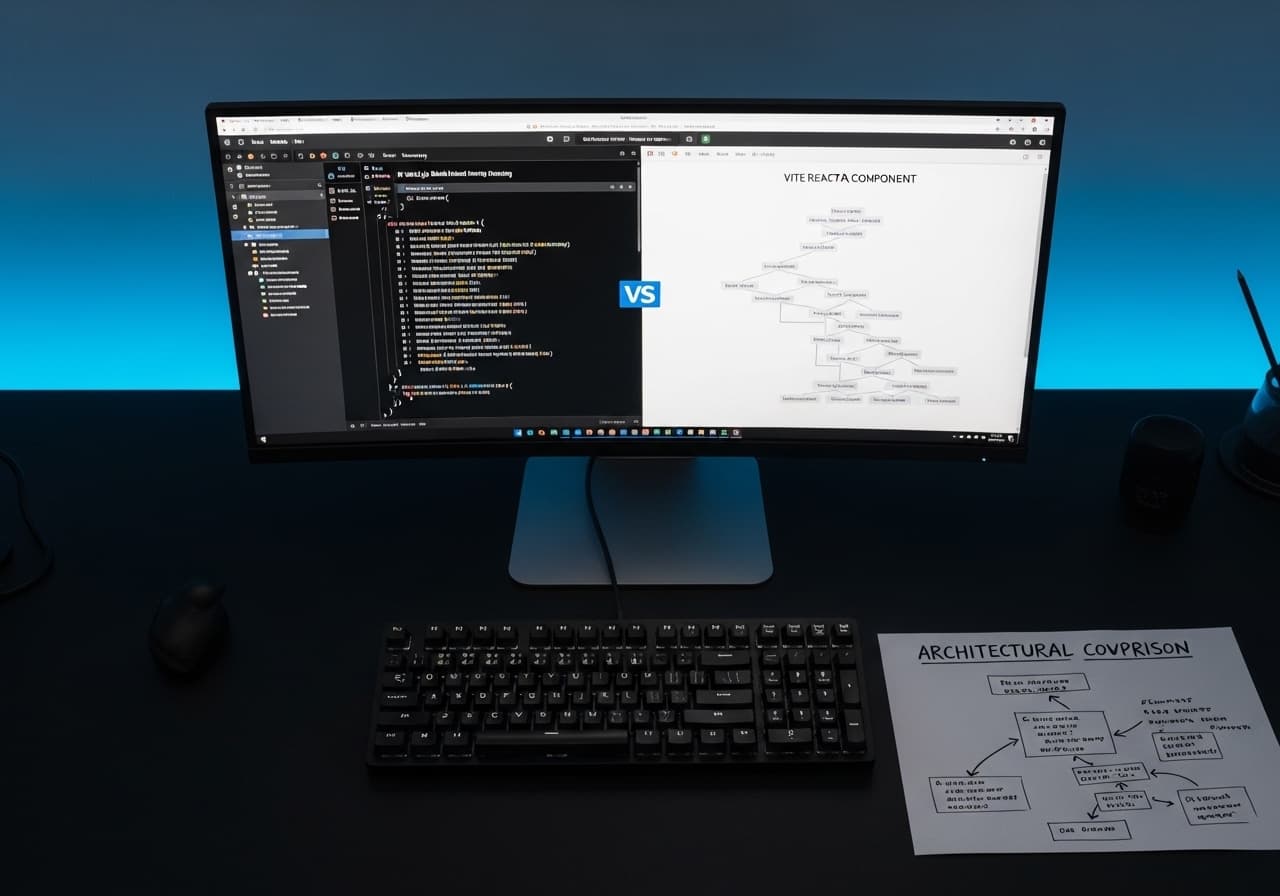
Next.js vs React SPA: When to Use What
Next.js is a React framework that adds server-side rendering, static generation, React Server Components, file-based routing, and API routes to React. A React SPA (single-page application) is a client-rendered React application where all rendering happens in the browser using tools like Vite. The choice between them is an architectural decision that affects SEO, performance, deployment complexity, and development velocity — and the right answer depends on what you're building, not on which is more modern.
Next.js is the default for most new web applications in 2026. A React SPA is still the right choice for specific use cases.
How the Rendering Models Differ
React SPA (Client-Side Rendering / CSR):
The server sends a minimal HTML file and a JavaScript bundle. The browser downloads the JS, executes it, fetches data from an API, and renders the UI. First meaningful paint is delayed until JS is downloaded, parsed, and executed.
Next.js — Server-Side Rendering (SSR):
For each request, the server fetches data and renders the full HTML page before sending it to the browser. Fast first paint, immediately crawlable by search engines.
Next.js — Static Site Generation (SSG):
Pages are rendered at build time and served as static HTML from a CDN. Fastest possible load time; no server computation per request. For pages whose content doesn't change per-user (marketing pages, documentation, blog posts).
Next.js — React Server Components (RSC, App Router):
Components run on the server, fetch data directly (no API round-trip), and send rendered HTML + minimal JS to the client. Interactive components hydrate in the browser. RSC is the default in Next.js App Router.
Direct Comparison
| Factor | Next.js (App Router) | React SPA (Vite) |
|---|---|---|
| First paint speed | Fast (SSR/SSG/RSC) | Slower (JS must download first) |
| SEO | Strong (HTML served to crawlers) | Weak by default (JS-rendered) |
| Data fetching | Server-side, co-located with components | Client-side, separate API calls |
| Bundle size | Smaller (RSC only sends interactive parts) | Larger (full React tree in JS) |
| API routes | Built-in (Route Handlers) | Requires separate backend |
| Deployment | Requires Node.js server or edge runtime | Static files only (no server required) |
| Learning curve | Higher (RSC mental model is new) | Lower (standard React patterns) |
| Best for | Most web apps, SaaS, content sites | Dashboards, internal tools, apps behind auth |
When to Use Next.js
Any application with public-facing pages that need SEO. Marketing pages, landing pages, blog posts, documentation — anything a search engine needs to index must be server-rendered or statically generated.
SaaS applications. Static marketing pages (SSG) + authenticated application pages (RSC + Client Components) + API routes in a single codebase. See the startup tech stack guide for how this fits the full recommended stack.
Performance-sensitive applications. React Server Components reduce the JavaScript sent to the browser — faster initial loads and better performance on slower connections.
Applications that need an API layer. Next.js Route Handlers eliminate the need for a separate backend for most SaaS applications.
When a React SPA Is Still the Right Choice
Internal tools and admin dashboards behind authentication. If the application is never crawled by search engines, the SEO advantage of Next.js disappears. A Vite SPA is simpler to set up and easier to deploy for internal tools where SSR provides no benefit.
Highly interactive, client-state-heavy applications. Applications functioning more like desktop software — complex drag-and-drop interfaces, real-time collaborative editing, canvas-based tools — have UI state that doesn't map cleanly to the server-component model.
Teams new to React. The RSC mental model adds cognitive overhead. A team learning React for the first time will move faster with a standard Vite SPA and can migrate to Next.js once comfortable with React fundamentals.
Electron or desktop shell applications. Don't benefit from server rendering and are simpler as SPAs.
The Hybrid Reality: Next.js Handles Both
In a Next.js App Router application:
- Marketing pages and blog posts → Static Generation (SSG), served from CDN edge
- Application pages (behind auth) → Server Components + Client Components
- API endpoints → Route Handlers, no separate backend needed
A React SPA can only do the middle category. Next.js does all three in a single codebase — which matters for SaaS products where the marketing site and application are maintained by the same team.
Migration: SPA to Next.js
Next.js can import standard React components without modification. Migration steps: set up a Next.js project, configure routing to match existing routes, move API calls to server components where appropriate, update data fetching patterns. For a medium-sized SPA (20–30 routes), a full migration to Next.js App Router takes 4–8 weeks.
Magehire's web development team has migrated SPAs to Next.js for several clients where SEO and performance requirements outgrew the SPA architecture.
Ready to Choose the Right Frontend Architecture?
Architecture decisions made at the start of a project are expensive to reverse at scale. Magehire makes the SSR vs SPA decision as part of every technical discovery session — before writing any code. Schedule a strategy session to get the architecture right from the start.
?Frequently Asked Questions
Keep Reading
Explore more insights from our team

Etched Hits $5B Valuation and $1B Sales in AI Chip Market
Etched emerges as a formidable rival to Nvidia, achieving a $5 billion valuation and $1 billion in sales, reshaping the AI chip landscape.

How to Automate Business Processes With LLMs in 2026
Step-by-step framework for identifying which business processes are LLM-automatable, designing the pipeline architecture, selecting orchestration tools (LangChain, n8n, custom), and building validation layers that make outputs production-safe.
Scale Your Project
Ready to build high-performance software? Our experts in New York handle the technical heavy lifting so you can focus on growth.
Get a Free Consultation