

Non-Technical Founder's Guide to Managing Dev Teams
You don't need to write code to lead a tech company. But you do need to understand how your development team works — and what they need from you.
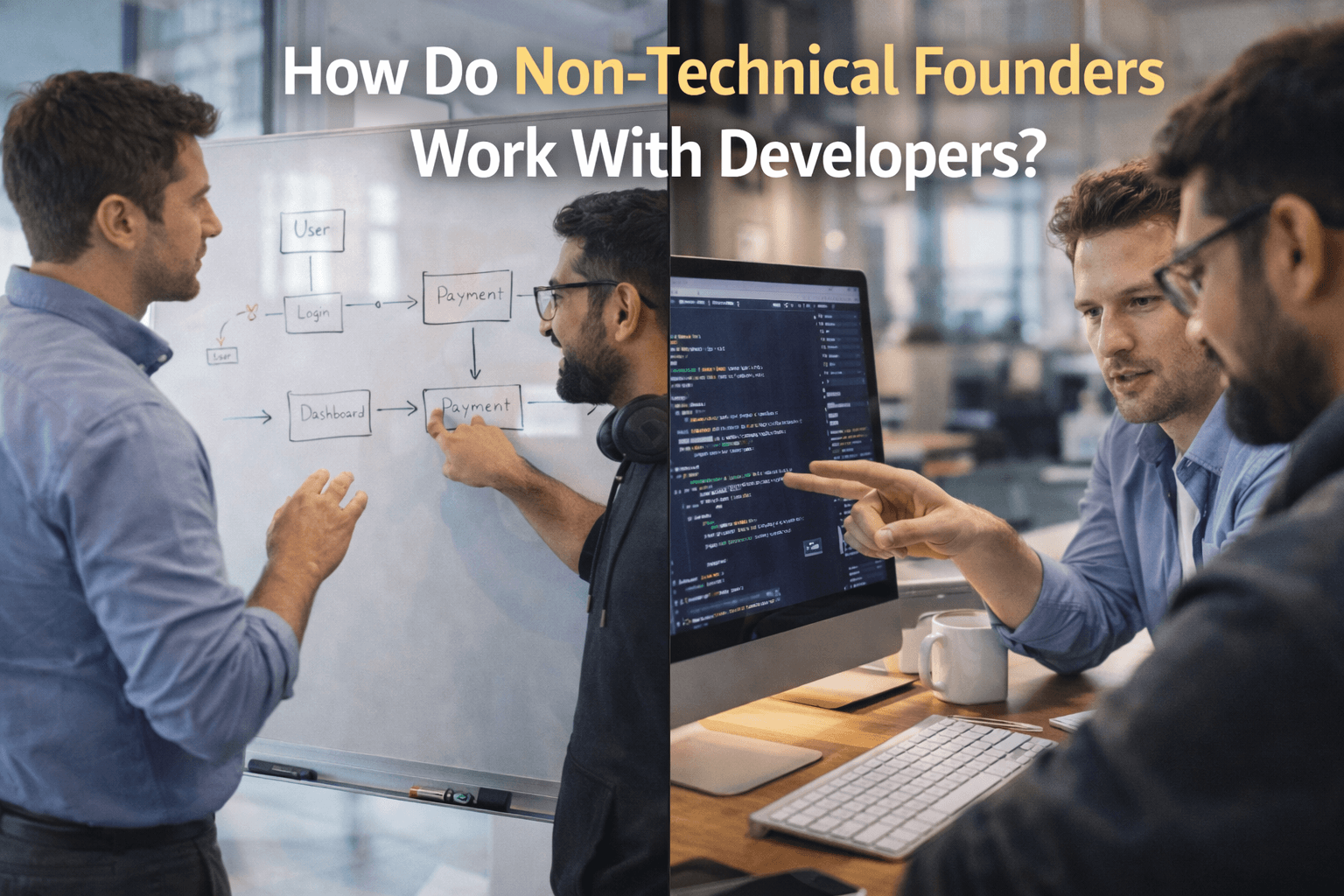
Bridging the Gap: Managing Developers as a Non-Tech Founder
You built a company. You raised funding. You hired a dev team. Now they're using words like "refactoring," "technical debt," and "CI/CD pipeline" — and you're nodding along while secretly Googling under the table.
You're not alone. Most non-technical founders feel this way. And the good news is: you don't need to learn to code. You need to learn to communicate.
The Translation Guide
Here are the phrases your developers use and what they actually mean for your business:
"We need to refactor this."
Translation: "The code works but it's messy. If we don't clean it up now, every new feature will take 2–3x longer." This is maintenance, not a waste of time.
"That's technically possible but not recommended."
Translation: "We can do it, but it'll create problems later." Listen to this warning.
"We have technical debt."
Translation: "Past shortcuts are slowing us down." Every product has some. It becomes a problem when it stops you from shipping new features.
"We need to write tests."
Translation: "We want to stop breaking things every time we add something new." This saves money long-term, even though it feels slow now.
"The estimate is 2–3 weeks."
Translation: "Best case 2 weeks, realistic case 3 weeks, worst case 4 weeks." Plan for the realistic case.
What Developers Need From You
Clear priorities, not clear solutions
Bad: "Add a dropdown menu in the sidebar that filters by date range."
Good: "Users need to find their recent transactions quickly."
You define the problem. Let them design the solution. That's what you're paying them for.
Decisions, not delays
The #1 thing that slows development teams is waiting for decisions. When your dev team asks "should we support social login or email-only?" — answer within 24 hours, not next week.
Indecision is more expensive than a wrong decision. You can always change features. You can't get back lost sprint time.
Realistic timelines, not pressure
Pressuring developers to commit to unrealistic deadlines doesn't make the work go faster. It makes them cut corners, skip testing, and ship bugs.
Ask: "What can we realistically ship by [date]?" not "I need all of this by [date]."
Context, not micromanagement
Developers do their best work when they understand why something matters. Share customer feedback, business goals, and revenue targets. When they know the context, they make better technical decisions.
How to Run Effective Standups
If you're joining daily standups, keep it focused:
Each person answers three questions:
- What did I complete yesterday?
- What am I working on today?
- Is anything blocking me?
Your job as founder: unblock. If someone is waiting for a design decision, API access, or stakeholder approval — that's your problem to solve. Let developers develop.
Red Flags to Watch For
Even without technical knowledge, you can spot problems:
- No demos for 3+ weeks — Something is stuck. Healthy teams show working software every 1–2 weeks.
- "It's almost done" for 2+ weeks — The last 10% takes 50% of the time. Push for specific remaining tasks.
- No tests, no code review — This means bugs are piling up silently.
- One person knows everything — Bus factor of 1 is a business risk. Insist on documentation and knowledge sharing.
Building Trust
The best founder-developer relationships are built on mutual respect:
- Trust their estimates even when they seem high
- Celebrate shipped features not just revenue milestones
- Include them in product decisions — they see technical opportunities you don't
- Protect their focus time — every Slack ping during deep work costs 20 minutes of productivity
Your development team wants to build great software. Give them clarity, decisions, and space — and they will.
Looking for a dev team that communicates clearly with non-technical founders? That's what MAGEHIRE does best. We explain everything in plain language and keep you in the loop without the jargon.
Related expertise: Scale your product with our Backend Engineering and B2B SaaS Development services.
What is Bridging the Gap?
This solution focuses on solving core business challenges through strategic technical implementation. At its heart, it leverages modern engineering to drive operational efficiency and scalability.
How it Works
Magehire follows a rigorous 4-step methodology to ensure delivery excellence:
- Discovery: Mapping business goals to technical requirements.
- Architecture: Designing scalable, future-proof systems.
- Agile Build: Iterative development with transparent progress tracking.
- Launch & Scale: Strategic deployment and continuous optimization.
Primary Use Cases
- B2B SaaS: Building multi-tenant platforms with complex permission logic.
- Enterprise Modernization: Transitioning legacy systems to modern cloud infrastructures.
- AI Integration: Automating repetitive workflows to reduce operational overhead.
Cost and ROI Analysis
Investing in professional development is about long-term value. While initial costs range based on scope, the return on investment (ROI) is realized through reduced maintenance costs, improved user adoption, and the ability to scale without technical debt blocks.
When to Choose This Solution
Choose this approach when your business requires a high degree of customization, reliability, and technical leadership that generic off-the-shelf solutions cannot provide.
?Frequently Asked Questions
Keep Reading
Explore more insights from our team

Etched Hits $5B Valuation and $1B Sales in AI Chip Market
Etched emerges as a formidable rival to Nvidia, achieving a $5 billion valuation and $1 billion in sales, reshaping the AI chip landscape.
How to Automate Business Processes With LLMs in 2026
Step-by-step framework for identifying which business processes are LLM-automatable, designing the pipeline architecture, selecting orchestration tools (LangChain, n8n, custom), and building validation layers that make outputs production-safe.
Scale Your Project
Ready to build high-performance software? Our experts in New York handle the technical heavy lifting so you can focus on growth.
Get a Free Consultation